
What’s the point of being fit? Have you ever asked yourself this simple question?
Many would say it’s to ensure we have a long, wholesome life; some kind of biological duty to our own bodies, to stay in mint condition until we finally succumb to old age and die, leaving an unblemished corpse.
For me, fitness and health are just a means to a larger end – something to enable me to live as I wish, to accomplish what I want, to face any challenge and adversity that may come my way and do my best to overcome it. Fitness isn’t the goal in and of itself; it’s just a tool, a part of my training which in itself is simply to allow me to follow my path for as long as I desire. It’s a by-product of living my life to the fullest, nothing more.
There is a powerful movement in the conventional fitness industry at the moment towards the idea of ‘functional’ and ‘movement-based’ fitness, with an emphasis on grand terms like ‘multi-planar mobility’ and ‘functional movement screening’. Then you get shown into a gym and put to work training for, usually, some approximation of functionality.
But when do you ever use it? What’s the point of all this ‘functional fitness’ if it never gets used? Imagine sharpening a wood-axe for days, months, years; keeping it pristine and clean and ready… and never chopping any wood. Imagine having a Ferrari or a Yamaha R1; polishing it, tuning the engine, upgrading it with incredible suspension, a racing gearbox, new tyres… and never taking it out to tackle some corners. It happens all the time in physical training circles, and never gets questioned. Why? It’s the same as training for years in a martial art, becoming fast, strong, precise… and never once stepping into the circle of sand to see how you do in an actual fight. After all, that’s the purpose, right? That’s the function.
Real-World Training

I think there is a danger that we come to focus on the ‘being fit’ part as the goal itself. We’ve become so good at the science of getting fit and healthy that we can forget what the original point was, and miss the wood for the trees. And somewhere along the way having a perfect physique, or being able to do 100 kipping pull-ups, or having ideal form on a squat becomes the actual purpose of our training. Now, all those things are fine as purposes if that’s what you set out to do as your initial goal. But if you are setting out to be a fully capable human being with practical movement abilities, it’s not enough. You’ve got to test it.
For me, we know nothing until we test ourselves. Until we test our training. That’s when we discover if all this talk of being functional actually has some substance. You don’t know if your training is functional if you only ever see the inside of a gym, or a weights room, or a yoga studio or dojo. You only know, for real, when you put your abilities to the test in the world – when you explore, face the unknown, climb some walls, fight someone, get from A to B, undertake an adventure of some sort. And it’s when we do this that we find how limiting our ‘training’ environment can be; how stratified, linear, isolated – unreal.
The world isn’t clean, or ordered, or safe, or structured. It’s unpredictable, throws challenges at you from every angle, keeps you off-balance, doesn’t wait for you to be well-rested or well-fed, expects Herculean effort from you without giving the slightest warning… it’s a crazy and unforgiving place. And that’s good! We need to embrace that: after all, being better at living in the world is what you’re training for.
And if, like most, you live in a town or city then your training has to fit that environment – has to become part of your daily life in that place. There isn’t much point becoming an expert in running through forests and swimming in the seas if 99% of your life is spent surrounded by the concrete jungle. That’s where you live, so that should be where you train. That’s where you need to be functional. (Of course, if you are lucky enough to live in a forest or by the sea then you should be getting good at those things!)
Further, you don’t live in a gym. You don’t live in a dojo. So get functional in your actual environment – the steel and stone and sharp edges of the urban landscape. Make your life your training. Try to flow through the unending crowds without slowing or having to stutter your steps. Pick a direction and explore, find ways around or over anything in your path. Keep your balance on a fast-moving train. Never take the escalators. Help someone carry their luggage. Climb down rather than taking the stairs. Run home rather than take the bus. If you’re not sure whether you can do something – try it. Find out.
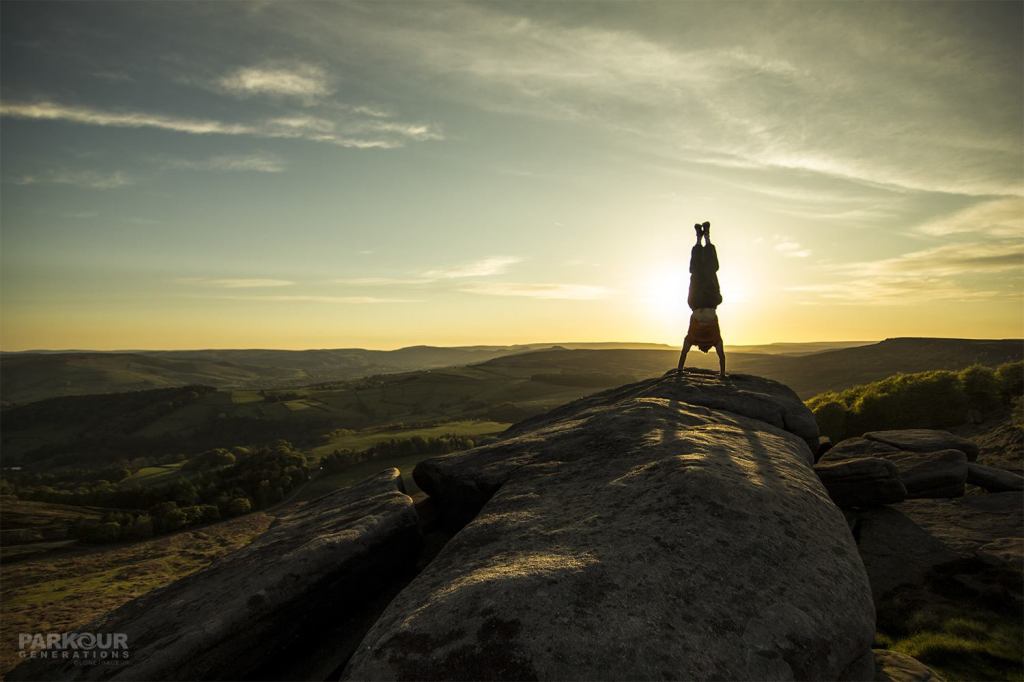
That’s why I fell in love with parkour from the start. It doesn’t ask you to spend years in a gym, with training wheels on, preparing for the idea of an adventure or a challenge that never actually comes. Quite the opposite: I realised early on that parkour wouldn’t keep me from those adventures at all. In fact, the training itself necessitates adventure. Exploration, discovery, constant real-world testing, adaptation… these things are core to the discipline, and are inherent in the training. In parkour we are constantly doing what most others only ever train for.
And that’s awesome.
“What I know now; it is very, very simple, and there are no tricks, really. Play the game by your lonesome, on short rations, as hard as you can, and if you keep your mind to the search and your eyes open, you will eventually find it. And after you’ve found it once twice, and again, it will begin to stick – the power and the bliss will work itself into the grain of your life, changing everything. It is true, and that’s that.” – Rob Schultheis


 Dan Edwardes
Leave a reply to mjjeffers Cancel reply