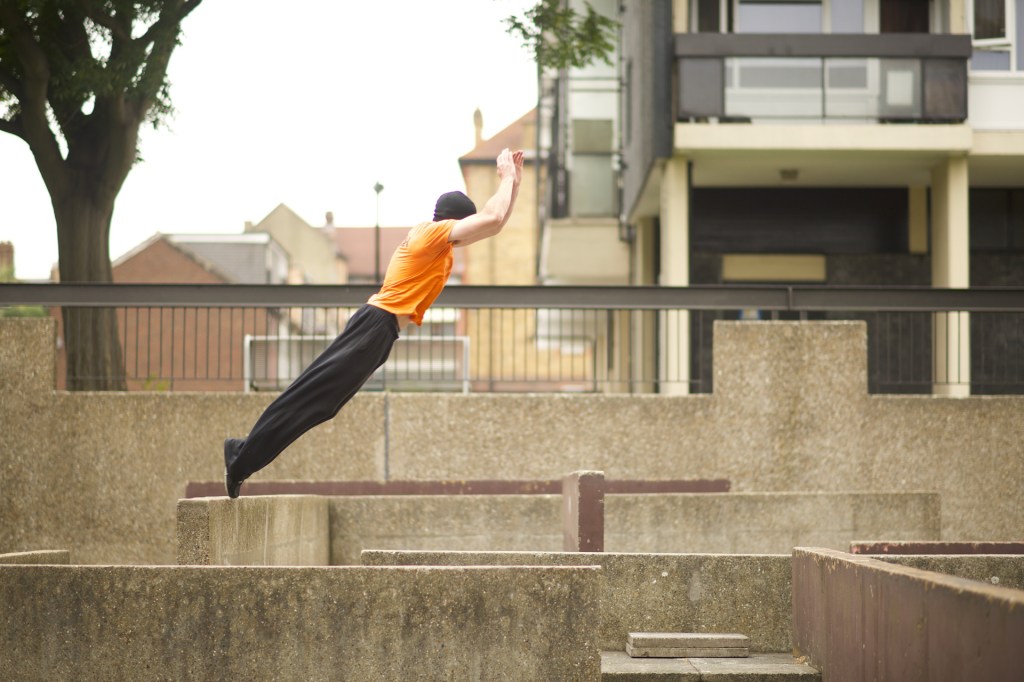
Parkour was born out of the process of solving movement problems, or challenges.
They began simple – can we cross this gap; can we climb this building; can we balance along this railing; can we vault this wall? Over time, as competence increased, the complexity and demands of the problems increased, which powered the continual adaptation and evolution of the movement skills within parkour.
This, then, is the central mechanism of parkour training: adaptation to new problems.
The most common training method is to search for movement problems within a given environment, then attempt to solve them through iteration and adaptation. This process requires us to stretch our abilities, to make countless small adaptations in order to find a good solution.
The particular problem might be unique to that location, but the adaptation it produces will go on to enhance and improve your movement capacity in general, and considerably.
The beauty of the parkour approach to movement is that it generates a high level of physical literacy in a relatively short space of time, because it is essentially the same mechanism as found in the natural play of children – the protocol the brain implements naturally in order to develop the body as much as possible for the rigours of adult life!
 Dan Edwardes
Leave a comment