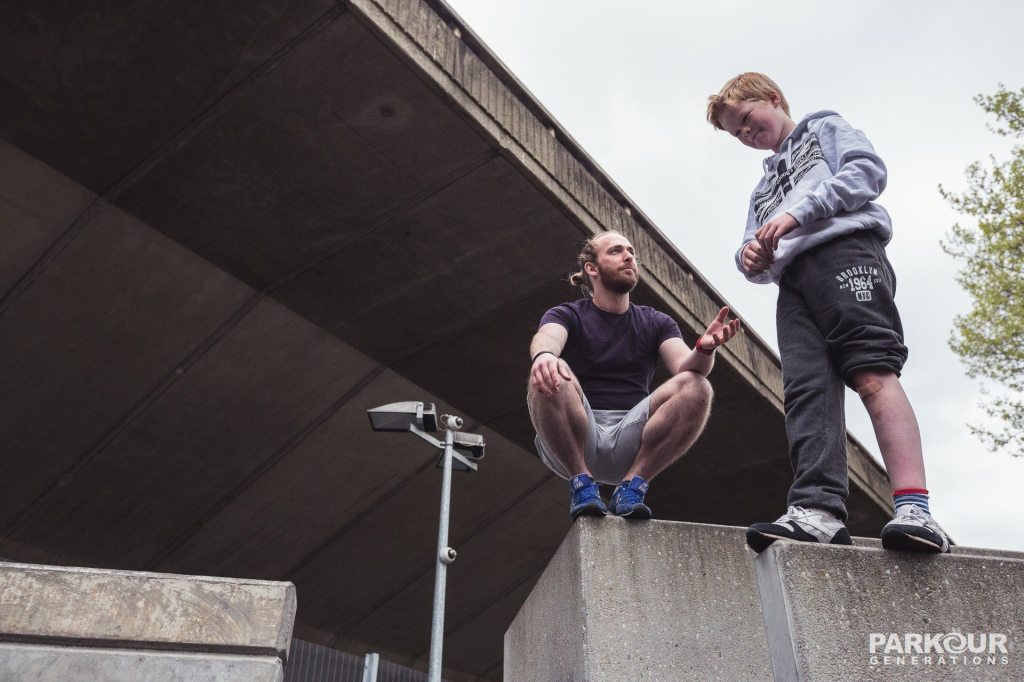
Coaching in parkour – and in movement practices in general – carries a particular tension.
On one hand, there is a responsibility to support safety, learning, and progression: On the other, there is the risk that too much guidance can quietly remove the very processes parkour is meant to develop. Nowhere is this tension more evident than in the role the coach chooses to occupy within the learning environment.
“When coaches provide answers too quickly, they reduce the need for perception and decision-making.”
In many coaching contexts, the default role is that of the controller. The coach selects the task, demonstrates the solution, manages the risk, and corrects deviations. This approach is efficient and reassuring, particularly in group settings. But parkour did not emerge from being shown what to do – it emerged from individuals engaging directly with their environment, experimenting, failing, and discovering solutions through experience.
When coaches provide answers too quickly, they reduce the need for perception and decision-making. When they prescribe movement patterns, they limit exploration. When they intervene at the first sign of uncertainty, they prevent practitioners from learning how to navigate it themselves. Over time, this creates dependence rather than capability.
Control Versus Capability
Control feels responsible. It feels like good coaching. Clear instructions, predictable outcomes, and tightly managed sessions give the impression of safety and progress. But control also narrows the learning process. It positions the coach as the source of knowledge and the student as the executor, rather than as an active problem-solver – and this can actively counteract the most important lessons parkour is meant to impart.
Parkour is not a discipline defined by execution alone. Its deeper value lies in developing judgement, adaptability, resilience and self-regulation. These qualities cannot be instructed directly, no matter how much the coach bombards learners with information and exhortations. No, these qualities simply must be experienced.
When learning environments remove uncertainty, they also remove the need to think in motion. Practitioners may move well, but only under familiar conditions: the moment those conditions change, confidence falters and skills fail. This is not a failure of the student, but a predictable outcome of overly controlled teaching.
The Coach as Provocateur
The alternative is not a lack of structure, but a different form of leadership. The coach as provocateur – someone who intentionally stirs up strong, visceral responses in order to achieve a profound result – designs conditions rather than outcomes. Instead of giving instructions, they offer constraints. Instead of demonstrations, they pose problems. The focus shifts from transmitting knowledge to shaping experiences that invite learning to occur.
“We don’t need to give answers. We need to create the conditions through which answers arise.”
This approach requires trust: trust in the environment, trust in the learning process, and trust in the practitioner. It also requires patience. Learning driven by exploration is rarely linear or tidy, and there may be periods of struggle, frustration and hardship. Progress may be less immediately visible, but it is often deeper and more transferable.
Provocative coaching invites practitioners to engage actively with uncertainty. Faced with unfinished puzzles, they must assess risk, test ideas, and adapt in real time. But the key thing to remember is that these moments of hesitation and recalibration are not interruptions to learning; they are the learning.
Ownership Through Uncertainty
When solutions are not provided in advance, practitioners are forced to take ownership of their decisions. They begin to recognise their own thresholds, their own strategies, and their own patterns of response under pressure. This ownership is critical, because it shifts motivation from external approval to internal assessment.
“Autonomy is not taught by instruction; it is developed through taking on responsibility.”
Importantly, this does not mean abandoning guidance altogether. The coach still plays a critical role in framing challenges, maintaining appropriate boundaries, and offering reflection after the fact. Questions asked at the right moment can be more powerful than instructions given in advance. Feedback that encourages awareness can be more valuable than correction aimed at perfection.
Preserving What Makes Parkour Distinct
Over time, practitioners trained in this way develop a strong sense of agency. They become comfortable not knowing exactly what to do at first, and confident in their ability to figure it out. This comfort with uncertainty is one of parkour’s most distinctive outcomes, and one that extends far beyond physical movement.
This is a powerful lesson for all of us coaches to keep close at heart: when coaches act as provokers rather than controllers, they help preserve what makes parkour unique.
They create learning environments where creativity, judgement, and adaptability can emerge naturally. And in doing so, they honour the discipline’s origins and support its continued evolution – not by shaping practitioners into ideal movers or arbitrary technicians, but by supporting them in becoming capable, thoughtful and strong individuals who can engage with the world on their own terms.
 Dan Edwardes
Leave a comment