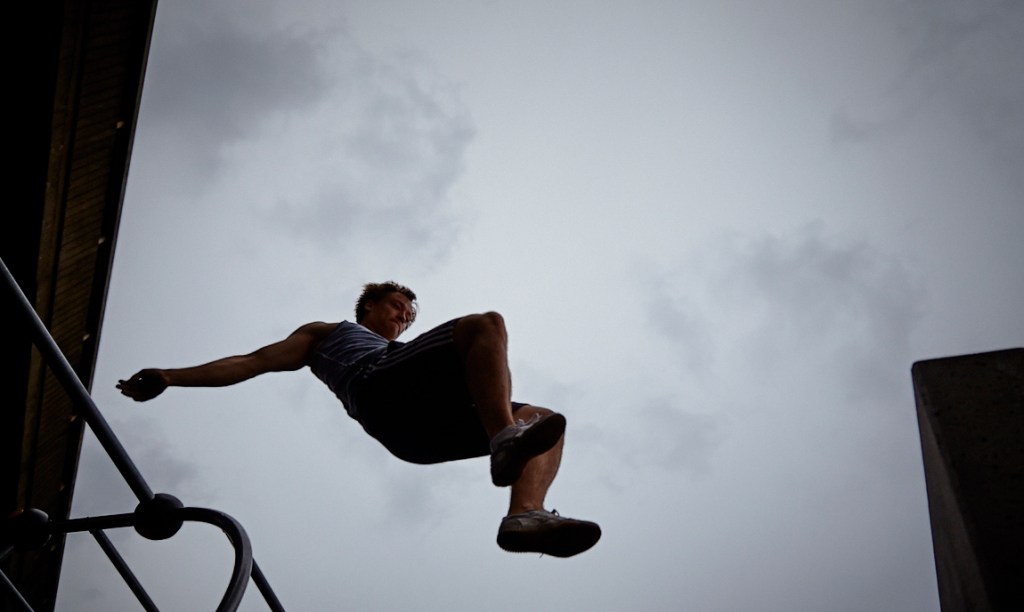
Old Philosophy – New Methods
Parkour has never stood still. If it had, it would have failed in its original purpose.
From the beginning, parkour was about adaptation — to environments, to constraints, to reality. That alone tells us something important: evolution is not a betrayal of parkour. It is a requirement.
And yet, while methods evolve, philosophy must remain anchored. Without that anchor, change becomes drift, and drift becomes confusion.
Today, parkour is more visible than ever. It is shared, edited, competed, branded, and consumed. None of these things are inherently wrong. But they do raise an essential question that every practitioner must eventually confront:
Why do you train?
What Parkour Was Never About
Parkour did not begin as a performance.
It was not designed for applause.
It was not a shortcut to recognition.
It was built on a far quieter idea: being useful — to yourself first, and by extension, to others.
Usefulness requires honesty. It requires an unglamorous relationship with your limits. It requires patience, repetition, and a willingness to be uncomfortable without being reckless.
The early philosophy was simple, but not easy:
- Train to be capable, not impressive
- Prioritise function over display
- Build strength that holds up under pressure
- Measure progress internally, not publicly
This wasn’t about minimalism or austerity. It was about clarity. Training had purpose. Movement had consequence. There was no need to decorate it.
The Shift Toward the External
As parkour became more visible, something subtle happened. The reference point began to move outward.
Instead of asking:
“Does this make me more capable?”
The question increasingly became:
“Does this look good?”
This is not a moral failing. It is a cultural pressure. Social platforms reward immediacy, novelty, and escalation. Parkour, like anything visually striking, fits neatly into that system.
But parkour does not respond well to being rushed.
Tendons do not care about algorithms.
Landings do not respond to hype.
Fear does not negotiate with editing software.
When training becomes shaped primarily by how it will be perceived, rather than what it will develop, the practice starts to hollow out. It may grow louder, but it becomes thinner.
Training as an Act of Self-Study
Proper parkour training is deeply revealing.
It shows you:
- how you manage uncertainty
- where ego overrides judgement
- how you respond to failure
- whether you value longevity or immediacy
You cannot hide from these things for long. A jump you cannot control will tell you the truth. A landing you cannot absorb will make the conversation very direct.
This is where parkour becomes more than physical training. It becomes a practice of self-regulation. You learn restraint. You learn patience. You learn to distinguish courage from impulse.
These lessons do not arrive dramatically. They arrive quietly, over years.
Discipline Is the Point
Discipline is not restriction.
It is direction.
The discipline of parkour lies in choosing:
- fundamentals over novelty
- consistency over peaks
- preparation over improvisation
This is not popular. It does not generate immediate excitement. But it produces something increasingly rare: durable capability.
A disciplined practice builds confidence that does not need to be proven. It creates athletes who move calmly rather than urgently, deliberately rather than desperately.
This is the kind of strength that lasts.
New Methods Are Not the Enemy
Better coaching, improved pedagogy, deeper understanding of biomechanics — these are not threats to parkour’s philosophy. They are expressions of it.
The original aim was effectiveness, not suffering.
If a new method:
- reduces unnecessary risk
- improves learning clarity
- increases accessibility
- supports long-term practice
…then it belongs in the evolution of parkour.
But methods must serve philosophy, not replace it.
When methods become detached from purpose, training becomes cosmetic. It may still be athletic, but it loses depth.
Competition and Expression
Competition and performance can coexist with parkour, but they must be held in proportion.
Parkour was never something you win.
It was something you become more capable through.
When competition rewards control, efficiency, and preparation, it can reflect parkour values. When it rewards risk escalation and spectacle alone, it distorts them.
The issue is not format. It is orientation.
A Practice That Ages Well
Perhaps the clearest test of any philosophy is time.
Practices built on ego burn brightly and fade quickly.
Practices built on discipline adapt as the body changes.
As practitioners age, the jumps may lower and the margins may widen — but awareness improves, efficiency sharpens, and judgement deepens.
This is not decline.
It is refinement.
Parkour, practiced properly, does not end when youth does. It simply changes emphasis.
Remembering What Parkour Is For
Parkour does not need defending. It needs remembering.
Remembering that:
- movement is a means of understanding, not validation
- strength is built quietly before it is expressed
- progress is measured in capability, not visibility
- the deepest outcomes are internal
Old philosophy does not mean outdated thinking. It means timeless principles applied through modern understanding.
If parkour continues to evolve while remaining anchored to its original values — functionality, discipline, humility, and self-knowledge — it will remain relevant long after trends move on.
Not as a spectacle.
Not as a shortcut.
But as a practice worth committing to — for life.
 Dan Edwardes
Leave a comment