Over the past few decades, something subtle but profound has changed in how we relate to risk, particularly when it comes to children.
Beginning in the 1990s and accelerating ever since, Western societies have increasingly organised themselves around the idea that safety is not just a priority, but a moral imperative. Risk has come to be seen less as a fact of life and more as a failure of planning, supervision, or care. The result was the gradual emergence of what is often called the “nanny state” and what psychologists now describe more precisely as safetyism: a belief system in which discomfort, uncertainty, and challenge are treated as inherently harmful.
I’ve seen the terrible, negative effects of this safetyism first-hand in my 20+ years travelling the world to teach movement.
In Hong Kong the Ministry of Education told me that schools require children to visit the nurse whenever they fall over, no matter what: the result is that children visit the school nurse a few hundred times per year. Each.
In Saudi Arabia, the physical illiteracy of children in the private schools was just astounding to behold, compared to the incredible physical competence and resilience of the disadvantaged kids raised on the street.
In the UK, a PE teacher once told me she had been instructed by her governing body that press-ups were ‘dangerous’ for children under the age of 10 and therefore kids shouldn’t be crawling on the ground. When I reminded her that one of the first movements infants engage in is to push their chests of the ground, she looked a little nonplussed.
I could identify hundreds of similar examples, from across every continent.
This shift towards safetyism, of course, was well-intentioned. Fewer injuries, fewer accidents, fewer tragedies – surely that would be the natural outcome? But as Jonathan Haidt and others have demonstrated in works such as The Anxious Generation, not only was that not the case, but the unintended consequences of this approach are becoming increasingly clear and increasingly serious. When young people are systematically shielded from risk, they do not become safer adults; they become more anxious, less resilient, and less capable of navigating uncertainty. They grow up incapable.
Because a world stripped of challenge does not produce strong, confident humans; it produces fragile ones.
The Disappearance of Movement and Real-World Play
One of the quiet casualties of this cultural shift has been movement itself. Children play outside less; they roam less; they engage with rough-and-tumble play far less than previous generations. In many urban environments spontaneous outdoor play has become tightly controlled, structured, or discouraged altogether – Play England revealed that most urban children spend less than 20 minutes a day outdoors, and have 90% less space to roam than they did only 30 years ago. Where the physical world once offered endless invitations to experiment, today it is often treated as something to be navigated cautiously, under supervision, or not at all.
At the same time, screens have filled the gap. Digital spaces offer stimulation without risk, interaction without consequence, and reward without effort. They are frictionless environments, optimised for comfort and engagement rather than growth. While technology brings many benefits, it cannot substitute for the developmental role of real-world movement. Virtual challenges do not teach the body how to manage fear, calibrate effort, or recover from failure. They do not build a felt sense of competence.
Human beings, particularly young ones, need resistance. They need situations that ask something of them. They need opportunities to test themselves against the world and discover, through experience, that they can cope. Risk, when it is appropriate and self-chosen, is not a threat to development; it is in fact one of its primary drivers – and an essential one, at that.
Parkour as a Counter-Narrative to Safetyism
This is where parkour occupies a uniquely important position.
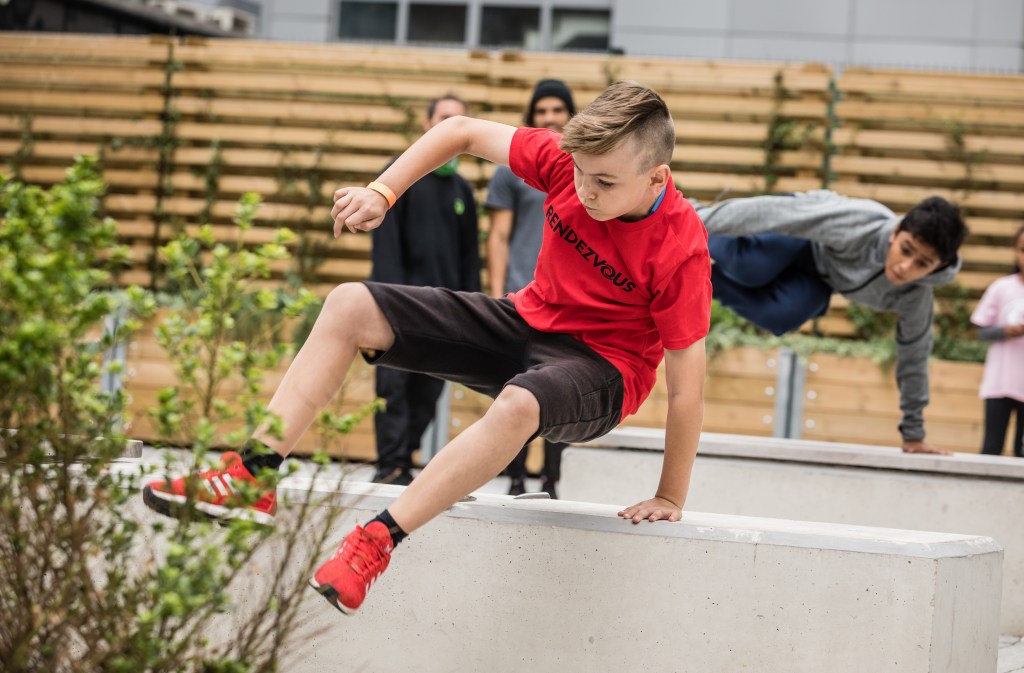
Parkour offers a structured relationship with risk without removing it entirely: it does not eliminate challenge, instead it teaches young people how to approach it intelligently. Through engaging with movement challenges young practitioners learn to assess situations, manage fear, make decisions under pressure, and take responsibility for their actions. These are not abstract skills – they are embodied, practical, and deeply transferable.
Parkour does not eliminate risk. It teaches people how to meet it.
For children growing up in increasingly urban environments, parkour provides a way to reconnect with the physical world. Walls become invitations rather than barriers. Railings become opportunities to test balance and judgement. Stairs, gaps, and ledges become problems to be solved rather than hazards to be avoided. In this way, the city itself becomes a landscape for learning.
Crucially, parkour does not promote recklessness. It encourages progression, self-awareness, and respect for limits. The risk is real, but it is modulated through skill, preparation, and choice. This distinction matters. The goal is not to chase danger, but to develop the capacity to engage with uncertainty calmly and competently.
The Role of Parents: Choosing Courage Over Control
For this process to work, however, adults must also adapt. Parents, in particular, play a decisive role in shaping how children relate to risk. In recent decades, well-meaning concern has often drifted into overprotection. Helicopter / lawnmower / bulldozer parenting – characterised by constant monitoring, intervention, and obstacle removal – is now widely documented as being associated with higher anxiety, lower resilience, reduced autonomy, and poorer problem-solving skills in children.
This kind of parenting hasn’t worked, clearly. In fact, it’s produced the first generation of children who are less cognitively capable – by almost every metric – than their parents. It’s important to understand that the deficiencies every PE teacher now sees in their young students is not the fault of the children themselves: it’s the fault of the adults who took away the environment these children required for healthy development. We have sabotaged the natural childhood of an entire generation.
Protecting children from every possible fall, failure, or moment of discomfort does not prepare them for life; it simply delays their encounter with it and reduces their capacity to handle it. And when risk is removed early, it reappears later – and often in more destabilising forms. We just end up making the risks far higher and the consequences more severe by kicking that can down the road.
Allowing children to take physical risks requires parental courage, I realise. It means tolerating uncertainty, trusting in gradual development, and accepting that scraped knees and shaken confidence are part of healthy growth. This does not mean abandoning care or responsibility, though: it means redefining them.
True care is not about removing all risk. It is about preparing children to meet it.
Parkour offers parents a rare reassurance: a context in which children can experience risk in a supported, progressive, and intelligent way under the guidance of strong role models who have themselves trodden the path of challenge and adversity in their own training. Parkour provides visible learning, tangible skill development, and a framework for understanding fear rather than suppressing it.
Building Confidence That Travels
As children engage with parkour, they develop a particular kind of confidence – not the brittle confidence that depends on perfect conditions, but the durable confidence that comes from having faced and overcome difficulties on a regular basis. They learn that fear can be informative rather than paralysing, that mistakes are part of learning, and that capability is built gradually through effort and attention.
This confidence does not remain confined to movement either: it influences how young people approach challenges in school, in relationships, and in unfamiliar situations. It builds adaptability rather than teaching avoidance.
Parkour also restores something that has been steadily eroded: the crucial sense of ownership over one’s environment. My generation had this as children, because we were allowed to roam under our own devices and explore the world. This, I believe, is because we were not the constant centre of our parents’ attention – families were not so child-centric as they are now, which took the pressure of us as kids and forced us to find our own way and develop our own sense of self-worth. We had to create it rather than wait to be given it.
This freedom is absolutely essential in a healthy childhood. When children are allowed to move freely, to explore, and to test themselves, they develop an active relationship with the world. They are not merely consumers of adult-designed experiences; they are active participants in their surroundings, creators of their own experiences, and this gradual move towards autonomy is a huge aspect of what it is to ‘grow up’.
Preparing for an Uncertain Future
If we are concerned about rising anxiety, declining resilience, and a loss of creativity, then we need to look beyond comfort and safety as solutions. We need to reintroduce meaningful challenge into the daily life of our young. We need to allow children to move more, to play outdoors more, to encounter uncertainty in manageable doses, and to discover their own capacity to adapt.
Parkour does not claim to solve all of society’s problems, of course! But as a discipline, it does offer a clear and hopeful response to the blight on human society that is safetyism. It reminds us that competence is built through engagement, that confidence grows through experience, and that humans – even children – are remarkably capable when given the chance.
In a world increasingly organised around fear and protection, parkour quietly does something radical. It trusts young people with responsibility, invites them into adventure, and helps them grow into capable, resilient humans — ready to meet whatever the future might throw at them.
 Dan Edwardes
Leave a comment