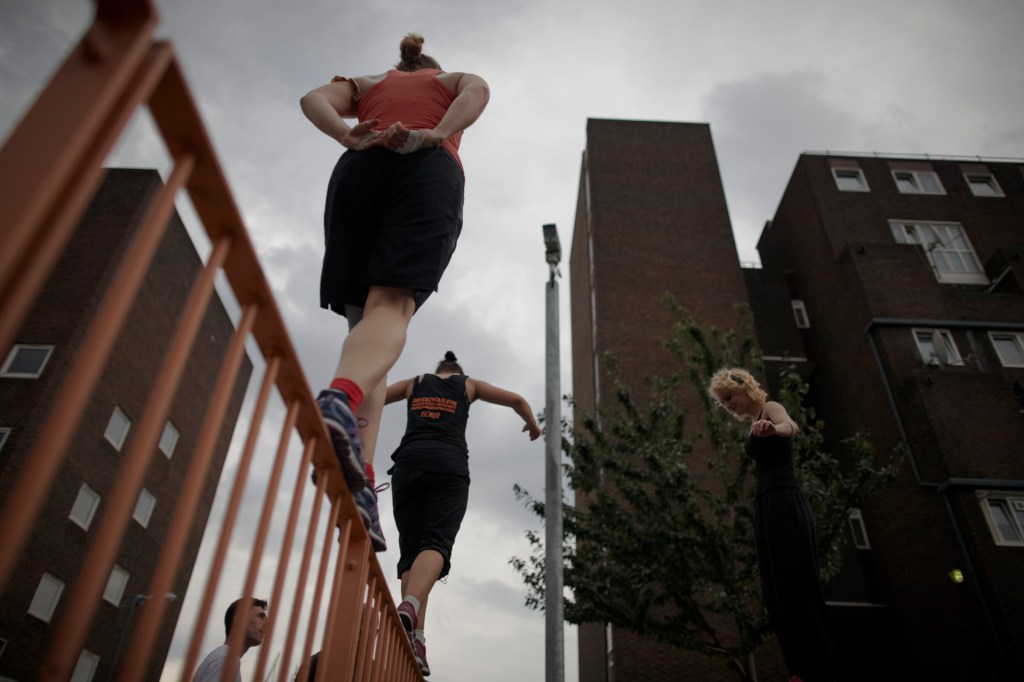
When we talk about teaching parkour, we too often begin with technique, progressions, drills, and structure. It’s a common mistake less-experienced coaches make, thinking it’s incumbent upon them to present clearly laid our progressions and endless details so as to convince newcomers that parkour is a ‘credible’ training discipline, and they a ‘credible’ teacher.
These elements are not unimportant, of course; they give us shared language, the perception of safety and control, and a way to introduce people to movement training in a supportive way. But when they become the primary teachers something subtle and significant is lost, because parkour was never meant to be delivered as a simple set of techniques and a curriculum alone. At its core, parkour is a conversation with the environment, and when we allow that environment to teach, learning takes on a very different character.
Parkour does not emerge from instruction alone, but from immediate interaction with the world around us. It’s shaped through direct, unfiltered engagement with obstacles, surfaces, distances, textures, and consequences as well. When those variables are smoothed out, standardised, overly controlled or even outright removed, we may produce competent movers, but we risk losing the deeper adaptability that truly defines the discipline and – worse – we risk losing the wild spirit that gave birth to parkour in the first place.
Parkour is not learned from the environment being explained, but from the environment being experienced.
Affordances for Movement: Seeing the World as It Can Be Used
The psychologist James J. Gibson introduced a concept that resonates profoundly with parkour, something he termed affordances for movement.
In his ecological approach to perception, the environment is not something we first interpret intellectually and then act upon. Instead, it presents us with immediate possibilities for action. A wall affords a climb. A rail affords balance. A gap affords a jump. These affordances are not fixed features of objects, nor are they purely subjective ideas; they exist in the relationship between a body and its surroundings, in what the environment offers to this person, in this moment.
This idea aligns closely with how parkour was meant to be learned, and in fact is central to how it arose in the first place. Parkour was always a pure response to environment, and the original ‘techniques’ all came about as individuals’ solutions to various challenges. That’s all. The intent was not to master movement for the sake of mastering movement, or to complete the most complex variation, or pull off the most dangerous stunt. Quite the opposite.
Practitioners do not move because they have memorised a technique, but because they perceive an opportunity and act upon it. That perception is refined through experience, not explanation. As capacity changes, affordances change too. What once afforded nothing becomes climbable, jumpable, achievable. In this way, the environment becomes a living teacher, constantly presenting new lessons as the practitioner evolves. And not only physical lessons but mental ones, too.
Indoor training environments, by contrast, often limit this perceptual richness. Obstacles are uniform, surfaces are predictable, challenges come pre-solved. While this can be useful for skill acquisition, it drastically narrows the range of affordances a practitioner must perceive and respond to. The environment stops asking questions and instead waits for rehearsed answers.
This removal of variables and simplification of environment, combined with the need to standardise technique in order to be able to measure it for competition purposes, is what gave birth to modern gymnastics. And gymnastics is an awesome discipline in and of itself – but it isn’t parkour. In fact, it’s antithetical to parkour. One is about constant exploration, problem-solving and adaptation; the other has worked hard to remove all of those elements.
Why Unplanned Environments Matter
When training takes place outdoors, in spaces not designed for movement training, everything changes. Surfaces are uneven; materials behave differently from what is expected; distances are irregular; angles make for awkward take-offs; and the tiniest factors can make outsized differences to one’s performance. Nothing is quite as it should be — and that’s precisely the point. That’s reality!
In these environments, movement cannot rely on repetition alone. Practitioners are required to judge, adapt, and decide in real time. Each action becomes a negotiation between intention and reality. This process develops a kind of intelligence that can’t be coached directly: perceptual awareness, decision-making under uncertainty, and the ability to remain calm and confident when conditions are unfamiliar.
Unplanned environments do not reward memorisation; they reward attention.
This is where parkour’s problem-solving roots truly emerge. Outdoors, there is rarely a single correct solution. Instead, there are many possible responses, each shaped by confidence, strength, fatigue, weather, and mood. Practitioners begin to understand movement not as something imposed on the world, but as something shaped by it.
Confidence That Extends Beyond Training
One of the most overlooked consequences of environment-led learning is the kind of confidence it builds. Confidence developed in highly managed settings often depends on those settings remaining stable; change the settings and the confidence evaporates. Take a gymnast out of the padded environment and you’ll often see their skills become unusable. Take a martial artist out of the dojo and you’ll often see them freeze up and forget their training. Confidence developed in the real world is different. It’s more grounded, more versatile, less fragile and more transferable.
When people learn to move in unpredictable environments, they develop trust in their ability to assess situations honestly and act appropriately. They become comfortable with uncertainty rather than threatened by it. This confidence is not bravado; it’s ownership. Ownership of one’s body, one’s decisions, and one’s place in the world.
This is why parkour, when practised primarily outdoors, has such a profound impact beyond movement itself. It teaches people to engage with the world rather than withdraw from it, to see obstacles not as hazards to avoid but as features to understand and negotiate. In this sense, parkour becomes a form of environmental literacy.
Real confidence is not knowing the answer in advance but trusting yourself to find one.
What This Means for Coaching and Practice
None of this suggests that indoor training, structure, or technical work have no place: of course they do. They are valuable tools, and when used well they can support confidence, safety, and physical development. But they must remain tools rather than destinations. If the majority of a practitioner’s training takes place in spaces where the environment has already been interpreted for them, then one of parkour’s most powerful teachers has been quietly removed from the process.
Environment-led learning asks something different of both coaches and practitioners. It asks us to prioritise experiences over explanations, and to trust that genuine understanding emerges through interaction rather than instruction. It asks coaches to design conditions instead of solutions, and practitioners to seek out spaces that resist simplification, that demand attention, judgement, and adaptation. In doing so, it keeps perception and action tightly coupled, as they are in the real world.
The ultimate irony in structured parkour education is that it can teach people how to move very well without teaching them how to be moved by the world around them. Affordances remind us that the environment isn’t a neutral setting; it is a teacher of perception, agency, and adaptation. When the majority of a practitioner’s training happens outdoors, in unpredictable spaces that are not “designed” for them, the discipline begins to deliver on its deepest promise. People begin to adapt, to personalise solutions, to think in motion, to expand their minds and to grow confidence that extends far outside the walls of any managed facility.
And that, ultimately, is why we speak of letting the environment teach. Not as a catchphrase, but as a commitment to the complexity, richness, challenge, and unpredictable beauty of real-world movement. Because when the environment is our teacher, parkour becomes more than a set of techniques performed well: it becomes a lived relationship with the world — and a path through which we learn to move not just effectively, but meaningfully.


 Dan Edwardes
Leave a comment