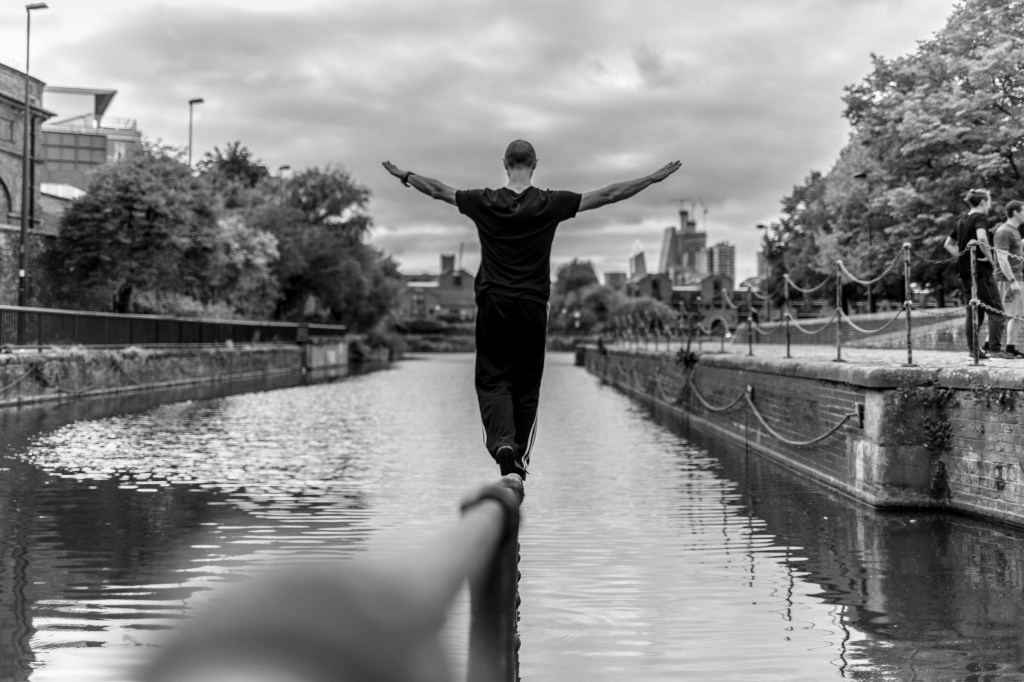
Parkour is often practised through repetition.
Movements are drilled, refined, cleaned up, and repeated again until they look and feel stable. This approach has obvious benefits: it builds coordination, strength, and technical understanding. But when repetition becomes the dominant mode of training, something essential is lost – because parkour is not defined by how well a movement can be repeated under identical conditions, but by how effectively it can be adapted when conditions change.
This is where variable practice becomes central. Not as a coaching trend or methodology, but as a reflection of how movement actually works in the real world. Outside of controlled environments, no jump is ever exactly the same. Distances vary. Surfaces behave differently. Timing shifts. Fatigue accumulates. Parkour emerged as a response to this variability, not as an escape from it.
Perfect repetitions create familiarity. Variable practice creates resilience.
When practitioners train the same movement in the same way, they become very good at that specific task, but their skill remains narrow. Small changes in context can cause performance to degrade quickly. This fragility is not a flaw in the practitioner; it is a predictable outcome of how the skill was learned.
Learning to Adapt, Not Just Perform
Variable practice introduces controlled instability into training. By changing take-off positions, approach angles, landing surfaces, or timing, practitioners are forced to adjust continuously. Each repetition becomes a problem to solve rather than a pattern to reproduce. This process strengthens perception-action coupling and develops adaptability, which is far more valuable than perfect execution under fixed conditions.
In parkour, adaptability is not an advanced skill to be layered on later. It is the foundation. Movement that cannot survive variation is not yet robust. Variable practice exposes weaknesses early, when they can still be addressed, rather than allowing them to remain hidden behind repetition.
This kind of training can feel uncomfortable. Performance often looks worse before it gets better. Movements become messier. Confidence may dip temporarily. But this discomfort is productive. It signals that learning is occurring at a deeper level.
Creativity Emerges from Variability
One of the unintended consequences of excessive repetition is the narrowing of creativity: when there is one correct solution, exploration stops. Variable practice reopens that space. By presenting the same movement problem in different forms, it invites multiple solutions and encourages practitioners to experiment and this experimentation is how parkour techniques arose in the first place.
Creativity in parkour is not about novelty for its own sake. It’s about having options. It’s about being able to respond when the expected solution no longer fits. Variable practice expands the range of available responses by continually asking the practitioner to adapt, in an ongoing process that had no culmination.
Creativity is not added to movement. It emerges from uncertainty.
This is why variable practice aligns so closely with outdoor training and environment-led learning. Unplanned environments naturally introduce variation – indoor training must do so deliberately.
Coaching for Robust Movement
For coaches, variable practice requires a shift in mindset. The goal is no longer to produce the cleanest repetition, but the most adaptable practitioner. This means accepting inconsistency in performance and understanding that short-term messiness often precedes long-term stability.
It also means designing tasks that resist being solved once and for all. Constraints change. Conditions shift. Success criteria evolve. The coach’s role becomes less about correcting movement and more about shaping experiences that demand adaptation.
When variable practice is missing, parkour risks becoming choreography — impressive under rehearsed conditions, but fragile when anything changes. When it is present, movement becomes robust, transferable, and resilient.
Why Variable Practice Matters
Variable practice sits at the heart of what makes parkour such a powerful and transferable discipline. It develops a quality of movement that is not dependent on repetition or familiarity, but on perception, judgement, and responsiveness. When practitioners train under changing conditions, they learn to remain organised in uncertainty, to adjust without hesitation, and to trust their ability to find workable solutions rather than perfect ones.
This kind of adaptability does not emerge from refinement alone: it emerges from exposure.
Each variation asks a new question, and each response adds to a growing internal library of experiences. Over time, practitioners develop movement that is not just technically competent, but context-sensitive. They begin to recognise patterns across difference, to feel when something is possible, and to adjust intuitively when it is not.
What makes variable practice especially powerful in parkour is that it mirrors the reality of the environments practitioners are preparing for. Real spaces are never consistent. Distances shift, surfaces behave unpredictably, and conditions change from moment to moment. Training that embraces variation prepares people for this reality directly, rather than abstractly. It teaches them to move with the world as it is, not as they wish it to be.
Perhaps most importantly, variable practice builds confidence that is earned rather than assumed. When people succeed across a wide range of conditions, they begin to trust their adaptability instead of relying on rehearsed solutions. This confidence travels easily. It shows up not just in movement, but in decision-making, problem-solving, and a willingness to engage with uncertainty rather than avoid it.
In this way, variable practice does more than improve performance. It supports the deeper aims of parkour: developing capable, creative individuals who can respond intelligently to unfamiliar challenges. By continually inviting variation into training, parkour preserves its relevance, its practicality, and its quiet power — not through repetition of the same answers, but through the cultivation of lasting capacity.
 Dan Edwardes
Leave a comment